
PERFORMANCE MARKETING
Performance Marketing Services in Vizag
Your advertising budget should do more than generate clicks. At OgimiTech, we build performance marketing services designed around your business goals, customer journey, and measurable outcomes.
Our approach goes beyond simply launching campaigns. We study your business, audience, market, competition, offer and conversion journey to build paid advertising campaigns around the outcomes that matter to your business.
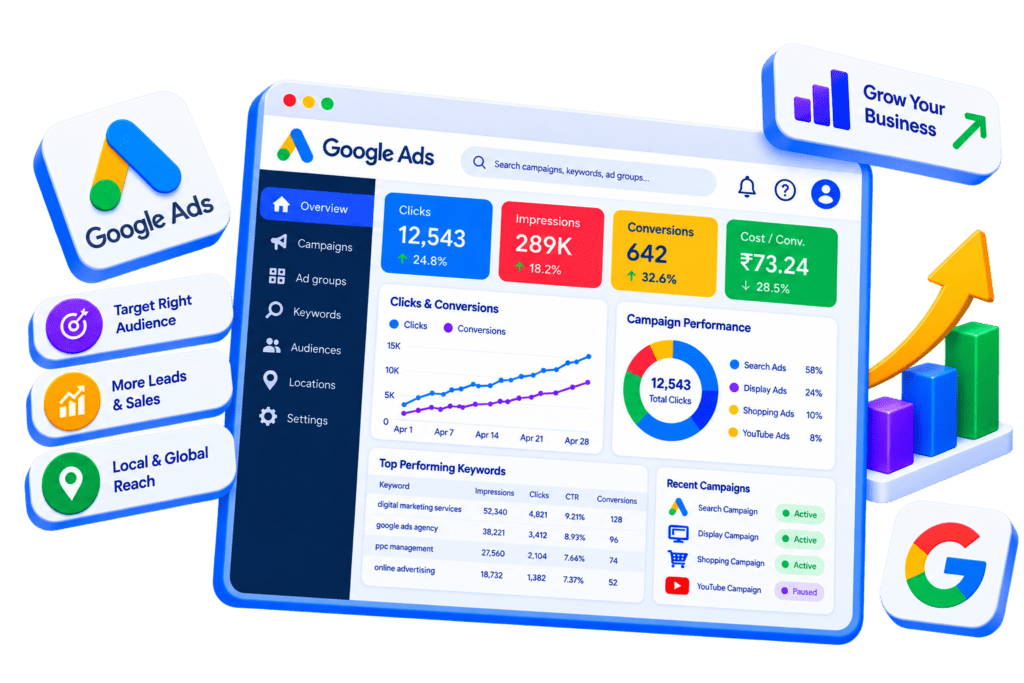
Getting traffic to your website is only one part of digital advertising.
You may already be spending money on Google, Facebook, Instagram, or other advertising platforms, but the bigger question is:
Are those campaigns actually contributing to your business growth?
Many businesses face challenges such as:
- Rising advertising costs
- Leads that are not relevant to the business
- Low conversion rates
- Website visitors without meaningful enquiries
- Incomplete or inaccurate conversion tracking
- Campaigns that are not optimized regularly
- Advertising budgets spread across different platforms without a clear strategy
- Difficulty understanding which campaigns actually generate business results
At OgimiTech, we look beyond clicks and impressions. We first understand your business model, audience, offer, customer journey, and objectives. Then we build campaigns around the outcomes that matter to your business.
What Is Performance Marketing
Performance marketing is a results-focused approach to digital advertising where campaigns are planned, measured and optimised around meaningful business outcomes.
Instead of focusing only on impressions, clicks or reach, performance marketing looks deeper into what happens after someone interacts with an advertisement.
The objective is not simply to get more traffic.
The objective is to attract the right people and create a measurable path from advertisement to conversion.
Depending on your business, the objective could be:
- Qualified leads
- Phone calls
- Form submissions
- Product purchases
- Bookings
- Applications
- Website conversions
- Revenue
- Lower customer acquisition costs
- Better return on advertising spend
Traditional marketing continues to have an important role in building awareness and reaching broader audiences. Performance marketing adds stronger measurement and optimization capabilities when the objective is to connect advertising activity with specific business outcomes.
| Area | Traditional Marketing | Performance Marketing |
|---|---|---|
| Audience Targeting | Often broad | More audience-specific |
| Measurement | Can be difficult to attribute precisely | Designed around measurable campaign data |
| Conversion Tracking | Often limited | Conversion events can be tracked |
| Budget Control | Planned around campaigns/media | Can be adjusted based on performance |
| Optimization | Often happens periodically | Continuous optimization is possible |
| Reporting | Focuses on campaign/media results | Connects activity with KPIs and conversions |
| Scalability | Depends on channel and reach | Winning campaigns can be tested and scaled |
| Business Outcomes | Awareness and reach can be key | Leads, sales, conversions and revenue can be key |
The right approach depends on your business objectives, audience, market, and customer journey.
At Ogimitech, our paid advertising strategy is built around your business objectives, target audience and customer journey. As a results-focused performance marketing agency, we focus on measurable business outcomes rather than clicks alone.
Google Ads & PPC Advertising
Reach potential customers when they are actively searching for products or services related to your business.
Our Google Ads approach can include:
- Search advertising
- Performance Max campaigns
- Display advertising
- YouTube advertising
- Remarketing campaigns
- Lead generation campaigns
- Keyword research
- Search-term analysis
- Negative keyword management
- Ad copy development
- Conversion tracking
- Campaign optimisation
Google Performance Max can distribute campaigns across multiple Google properties based on defined business goals and conversion signals.
- The goal is to create a clear roadmap for improvement.

Google Search Ads
Search Ads can help businesses reach users who are already expressing intent through relevant searches.
We focus on:
- Commercial search intent
- Keyword selection
- Match-type strategy
- Search-term analysis
- Negative keywords
- Landing-page relevance
- Geographic targeting
- Ad messaging
- Conversion tracking
- The goal is to improve the connection between what people search for, what your advertisement promises and what your landing page delivers.

Performance Max Campaigns
Performance Max is a goal-based Google Ads campaign type that can access multiple Google advertising channels from a single campaign. It can be used for objectives such as leads and sales, depending on the business and campaign setup.
We focus on
- Clear conversion goals
- Appropriate campaign structure
- Quality creative assets
- Conversion signals
- Audience insights
- Budget allocation
- Performance monitoring
- Ongoing optimisation
- At Ogimitech, we consider Performance Max as part of the wider advertising strategy rather than treating it as a one-size-fits-all solution.
Display & YouTube Advertising
For businesses that need awareness, remarketing or broader audience reach, Display and YouTube advertising can become part of the paid media strategy.
Campaigns can be designed around:
- Brand awareness
- Product or service promotion
- Remarketing
- Audience engagement
- Lead generation
- Supporting the wider customer journey
- Redirect analysis
- Duplicate content review
- Mobile optimization
- Website performance improvements
- The appropriate use of these channels depends on your business objectives and customer behaviour

Meta Ads Management
Facebook and Instagram can be powerful advertising channels for businesses that need to reach audiences based on interests, behaviours, demographics and engagement patterns.
Our Meta Ads services can include:
- Facebook advertising
- Instagram advertising
- Lead generation campaigns
- Website conversion campaigns
- Remarketing
- Audience research
- Creative testing
- Ad copy development
- Campaign monitoring
- Conversion tracking
- Rather than relying on a single audience or creative, we use structured testing to understand which combinations are generating meaningful results.

LinkedIn Advertising for B2B Businesses
For selected B2B campaigns, LinkedIn advertising can help reach professional audiences based on business and career-related characteristics.
Campaign strategy can focus on:
- B2B lead generation
- Decision-maker targeting
- Industry targeting
- Professional audience segmentation
- Lead forms
- Website conversion campaigns
- Remarketing
- LinkedIn advertising should be considered when the audience, sales cycle and customer value justify the channel.
Remarketing & Retargeting
Not every visitor converts during their first interaction with a business. Remarketing helps businesses reconnect with people who have previously interacted with their website, advertising or other digital touchpoints, where platform policies and tracking availability allow.
We look at factors such as:
- Returning website visitors
- Previous product viewers
- Engaged audiences
- Abandoned journeys
- Previous campaign visitors
- High-intent prospects
- The objective is to create another relevant opportunity for the user to take action.

Lead Generation Campaigns
For service businesses, local businesses and B2B companies, the goal may not be an online purchase
It may be:
- A phone call
- Enquiry form
- WhatsApp message
- Consultation request
- Appointment
- Site visit
- Demo request
- Quote request
- We structure campaigns around the conversion action that matters to your business. However, generating an enquiry is only one part of the process. Lead quality, response time and sales follow-up also influence the eventual business outcome.

E-commerce Advertising
For online stores, ecommerce performance marketing can support product discovery, consideration and purchase journeys.
Depending on the business setup, campaigns may focus on:
- Product promotion
- Shopping-related campaigns
- Performance Max
- Remarketing
- Product-specific campaigns
- Creative testing
- Conversion optimisation
- Revenue and ROAS analysis
- The objective is to understand not just how many people clicked, but how advertising contributes to transactions and revenue
Landing Page Optimisation
A successful advertisement cannot compensate for a poor conversion experience. If your advertisement attracts the right visitor but the landing page is confusing, slow, irrelevant or difficult to use, advertising efficiency can suffer.
Depending on the business setup, campaigns may focus on:
- Message consistency
- Headline clarity
- Offer presentation
- Calls to action
- Trust elements
- Mobile usability
- Form experience
- Page structure
- Conversion friction
- Relevance between ad and landing page
- The objective is to make the journey from ad click → landing page → action clearer.
Ad Creative & Copy Strategy
Your advertisement has only a limited opportunity to earn attention.
We develop advertising messages around:
- Customer pain points
- Benefits
- Offers
- Search intent
- Audience motivations
- Differentiators
- Calls to action
- Where appropriate, multiple creative and messaging variations can be tested to identify stronger performers.
Audience Research & Segmentation
Effective advertising starts with understanding who you are trying to reach.
We consider:
- Customer profiles
- Search behaviour
- Buying intent
- Location
- Demographics
- Interests
- Business characteristics
- Existing customer data
- Website behaviour
- Remarketing audiences
- This helps move campaigns away from broad assumptions and toward more relevant targeting.
Conversion Tracking & Analytics
Without reliable tracking, it becomes difficult to understand whether advertising is actually contributing to business results.
Depending on the campaign, tracking may include:
- Form submissions
- Phone calls
- WhatsApp clicks
- Website enquiries
- Purchases
- Booking actions
- Key website events
- Campaign sources
- Conversion rates
- The exact tracking setup depends on the website, advertising platforms and business model.
Continuous Campaign Monitoring & Optimisation
Launching a campaign is not the end of the process.
We monitor performance and identify opportunities to improve:
- Keywords
- Search terms
- Audiences
- Ad messaging
- Creatives
- Creative testing
- Landing pages
- Budget allocation
- Conversion paths
- Campaign structure
- The objective is to learn from campaign data and make informed adjustments rather than allowing campaigns to run without active management.
Google Ads
- Captures high-intent customers
- Reaches people actively searching
- Search-based targeting
- Best for ready-to-buy customers
- Drives immediate action
Meta Ads
- Creates new customer demand
- Reaches people while browsing
- Audience-based targeting
- Best for brand discovery & awareness
- Builds interest & engagement
01
Understand Your Business
Before recommending a campaign, we first understand:
- What you sell
- Technical SEO issues
- Your business model
- Your target market
- Your competitors
- Your sales process
- Your current advertising
- Your business objectives
Because advertising strategy should begin with the business not the advertising platform.
02
Research the Market & Competition
We analyse the competitive environment to understand:
- What competitors are communicating
- How the market is positioning similar offers
- What customers may be searching for
- Where opportunities may exist
- What messages could differentiate your business
This provides strategic context before campaign planning begins.
03
Identify the Target Audience
We define the audiences most relevant to your campaign. Depending on your business, this may include people based on:
- Search intent
- Location
- Demographics
- Interests
- Professional characteristics
- Website behaviour
- Previous engagement
04
Build the Campaign Strategy
We determine:
- Which advertising channels make sense
- Campaign objectives
- Budget allocation
- Audience strategy
- Keyword strategy
- Conversion goals
- Landing-page requirements
- Creative requirements
Not every business needs every advertising platform.
05
Keyword & Audience Research
For search campaigns, we identify relevant commercial search opportunities and refine keyword targeting.
For audience-based campaigns, we develop relevant audience segments and testing structures.
This helps connect advertising with the people most likely to become customers.
06
Campaign Setup
We structure campaigns with appropriate:
- Campaigns
- Ad groups or asset groups
- Keywords
- Audiences
- Ads
- Extensions/assets
- Locations
- Budgets
- Bidding approaches
- Conversion goals
The setup is designed around the campaign objective rather than a generic template.
07
Ad Copy & Creative Development
We develop advertising messages designed to communicate:
Problem → Value → Differentiation → Action
Where creative testing is appropriate, different messages and formats can be tested against
campaign objectives.
08
Conversion Tracking
Before relying on campaign data, we establish the appropriate conversion tracking wherever technically possible.
This helps answer a critical question:
Are our campaigns generating meaningful actions or simply generating traffic?
09
Campaign Launch
Once targeting, tracking, messaging and campaign settings are reviewed, campaigns are
launched and monitored.
Initial campaign data provides the foundation for subsequent optimisation.
10
Build the Campaign Strategy
Performance marketing is an ongoing process. We review campaign data to identify:
- What is working
- What is underperforming
- Where budget is being wasted
- Which audiences show stronger signals
- Which keywords need refinement
- Which creatives need testing
- Where conversion friction exists
11
Testing & Learning
We use structured testing where appropriate. This may involve testing:
- Headlines
- Ad copy
- Creatives
- Offers
- Audiences
- Landing pages
- Calls to action
- Campaign structures
The goal is not to change everything at once. It is to learn what contributes to better performance.
12
Scale What Makes Business Sense
When campaigns, audiences or products demonstrate stronger performance, we can evaluate opportunities to allocate more budget.
When campaigns, audiences or products demonstrate stronger performance, we can evaluate opportunities to allocate more budget.
For businesses that depend on enquiries, calls, consultations or appointments, campaigns can be designed around
E-commerce Sales
For online stores, campaigns can focus on product discovery, purchase conversions, revenue and advertising efficiency.
Local Businesses
Local businesses can use location-focused advertising to reach customers within relevant service areas. Campaigns may focus on:
- Calls
- Directions
- Enquiries
- Appointments
- Local services
- Store visits
B2B Businesses
B2B advertising often requires a different approach because the buying process can involve multiple decision-makers and longer sales cycles. Campaigns can therefore be designed around qualified enquiries, consultations, demos or ead nurturing.
Service-Based Businesses
For consultants, agencies, professional services and other service providers, campaigns can be structured around enquiries, calls, bookings or consultation requests
Education Businesses
Advertising can support objectives such as:
- Course enquiries
- Admission enquiries
- Counselling requests
- Application leads
- Event registrations
Real Estate
Depending on the project and target market, paid advertising can support:
- Course enquiries
- Admission enquiries
- Counselling requests
- Application leads
- Event registrations
Healthcare
For eligible healthcare businesses, campaigns can focus on appropriate enquiry, appointment or consultation objectives while respecting advertising platform policies and applicable regulations.
Startups & Growing Businesses
Startups often need to balance growth opportunities with limited advertising budgets. A structured approach can help identify which audiences, offers and channels deserve further investment before aggressively increasing spend.
01
Strategy Before Spending
We don’t believe that increasing your advertising budget should be the first answer to poo campaign performance.We first look at the underlying problem.
02
Business-Focused Campaign Planning
Your campaign strategy should reflect your business model, customers, sales process and growth objectives.
03
Data-Driven Decision Making
Campaign decisions should be informed by relevant performance data rather than assumptions or vanity metrics.
- Calls
- Directions
- Enquiries
- Appointments
- Local services
- Store visits
04
Conversion-Focused Thinking
Clicks are useful only when they contribute to the next stage of the customer journey. We consider the entire path from advertisement to conversion.
05
Transparent Reporting
You should be able to understand:
- Where your budget is going
- Which campaigns are performing
- Which campaigns need attention
- What actions were taken
- What should be tested next
06
Continuous Optimisation
We treat campaign management as an ongoing process of testing, analysing and improving.ath from advertisement to conversion.
07
Audience & Competitor Research
Better campaign decisions begin with understanding the market, competitors and customers.
08
Local Market Understanding
Being based in Visakhapatnam gives Ogimitech an understanding of the local busines environment and customer context.
For businesses targeting local audiences, this can help inform location-specific campaign
planning.
However, local presence alone does not guarantee better results. Campaign performance still depends on strategy, offer, targeting competition, budget, tracking and execution.
09
Custom Strategies
Our performance marketing expert approach focuses on building a strategy around your specific business requirements rather than using a standard campaign template.
There is no universal advertising campaign that works equally well for every business. Your strategy should reflect your:
- Where your budget is going
- Which campaigns are performing
- Which campaigns need attention
- What actions were taken
- What should be tested next
A professional performance marketing campaign should measure more than clicks.
01
Cost Per Click — CPC
CPC tells you how much you are paying, on average, for a click. It helps evaluate traffic acquisition efficiency, but a low CPC does not automatically mean a campaign is profitable.
02
Click-Through Rate — CTR
CTR measures how frequently people click your advertisement after seeing it. A stronger CTR can indicate that your ad is relevant to the audience, although it must be considered alongside conversion quality.
03
Cost Per Lead — CPL
CPL shows how much advertising spend is required to generate a lead.However, the cheapest lead is not necessarily the best lead.
Lead quality matters.
04
Cost Per Acquisition — CPA
CPA measures the cost of acquiring a desired conversion or customer action. This can provide a more meaningful view of campaign efficiency than clicks alone.
05
Conversion Rate
Conversion rate measures the percentage of relevant visitors or users who complete a desired action. Improving conversion rate can help businesses get more value from existing advertising traffic.
06
Return on Ad Spend — ROAS
ROAS compares revenue attributed to advertising with advertising spend. For e-commerce and revenue-focused campaigns, it can be an important efficiency metric.
07
Customer Acquisition Cost — CAC
CAC considers the broader cost associated with acquiring customers. It can help businesses evaluate whether their customer acquisition approach makes commercial sense.
08
Revenue & Profitability
Ultimately, advertising should support the economics of the business. A campaign can generate thousands of clicks and still be commercially weak if those clicks do not lead to valuable customers.
First impressions matter, especially online. OgimiTech builds websites that put your business in the spotlight with a strong visual identity, clear messaging, and a smooth experience that keeps customers engaged. We combine thoughtful design, reliable development, and search-friendly website practices to create a digital presence that works for your business.
Better Audience Targeting
Reach audiences that are more relevant to your products or services.
Keyword Refinement
Improve keyword targeting based on actual search behaviour.
Negative Keyword Management
Exclude irrelevant searches where appropriate to reduce unqualified traffic.
Creative Testing
Test different messages and creative approaches to understand what resonates.
Landing Page Optimisation
Improve the experience after someone clicks an advertisement.
Conversion Tracking
Make campaign decisions using more reliable conversion data.
Budget Allocation
Evaluate which campaigns, audiences or products deserve more or less investment.
Remarketing
Reconnect with relevant users who have already interacted with your business
Continuous Optimisation
Review performance regularly instead of allowing campaigns to run without active management.
Working with a local performance marketing agency in India can provide practical advantages for businesses targeting Visakhapatnam and surrounding markets.
Local Customer Understanding
Local campaigns may require an understanding of how customers search, compare and choose businesses in the region.
Regional Market Context
A local team can bring useful context when evaluating regional competitors, offers and customer behaviour.
Easier Communication
Working with a nearby team can make discussions, strategy sessions and campaign reviews more convenient.
Faster Collaboration
When campaign requirements, landing pages, offers or business priorities change, closer collaboration can make coordination easier
Location-Specific Campaign Planning
Businesses targeting specific locations can structure campaigns around relevant service areas, locations and customer segments.
However, being local is only one advantage. Good performance still depends on strategy, execution, tracking, market conditions and continuous optimisation.
Results-Driven & Transparent Reporting
Advertising reports should help you make decisions not simply show you a collection of numbers. Our reporting approach can focus on meaningful information such as:
- Advertising spend
- Leads
- Sales
- Conversion rate
- Cost per lead
- Cost per acquisition
- Revenue
- ROAS
- Campaign performance
- Audience performance
- Search-term insights
- Creative performance
- Optimisation actions
More importantly, reporting should help answer:
What happened?
Why did it happen?
What are we changing?
What should we test next?
This turns reporting from a monthly formality into a tool for better marketing decisions.
Frequently Asked Questions
What does a performance marketing agency do?
A performance marketing agency plans, launches, monitors and optimises paid advertising campaigns across platforms such as Google, Meta and other relevant channels. The work can include audience research, campaign strategy, ad creation, conversion tracking, landing-page optimisation and performance reporting.
How much does performance marketing cost?
There is no single price that suits every business.
Costs can depend on:
• Number of advertising platforms
• Campaign complexity
• Advertising budget
• Number of products or services
• Creative requirements
• Landing-page requirements
• Tracking requirements
• Management scope
Is performance marketing suitable for small businesses?
It can be. Small businesses can benefit from measurable advertising when campaigns are built around clear objectives, appropriate targeting and realistic budgets. However, performance marketing is not automatically suitable for every business. The offer, market demand, competition, conversion process and economics all matter.
What is the difference between performance marketing and PPC?
PPC, or Pay-Per-Click advertising, is a form of paid advertising where advertisers generally pay when users click an advertisement.
Performance marketing is broader. It focuses on measurable business outcomes and can include PPC, paid social advertising, remarketing, conversion tracking, landing-page optimisation and other performance-focused activities.
How do you measure performance marketing success?
Success depends on the business objective.
Important metrics can include:
• Leads
• Sales
• Conversion rate
• CPL
• CPA
• CAC
• ROAS
• Revenue
• Profitability
The most useful metric is the one that connects advertising performance to your actual business objective.
Can Ogimitech manage Google Ads and Meta Ads?
Ogimitech can plan and manage paid advertising campaigns across relevant platforms based on your business requirements and campaign objectives. The recommended platform mix depends on your target audience, offer, budget and customer journey.
Why should I choose a performance marketing company in Visakhapatnam?
A local agency can provide practical knowledge of the regional business environment, easier communication and greater context for campaigns targeting local audiences. However, location alone does not determine campaign success. You should also evaluate an agency based on its strategy, transparency, tracking approach, communication, optimisation process and understanding of your business objectives.
How much should I spend on paid advertising?
There is no single budget that works for every business. The appropriate budget depends on factors such as your market, competition, customer acquisition economics, campaign objective, audience size, and conversion potential.
How long does it take to see results?
Timing varies depending on the industry, campaign objective, competition, budget, audience, offer, website experience, and available conversion data. Initial data can help identify optimization opportunities, while meaningful performance improvement generally requires ongoing testing and learning.
Data-driven campaigns, measurable results, and a growth partner for your business.
More Traffic
Reach the right audience across multiple channels.
Better Leads
Attract and convert high-quality leads.
Higher ROI
Get measurable results for sustainable growth.